
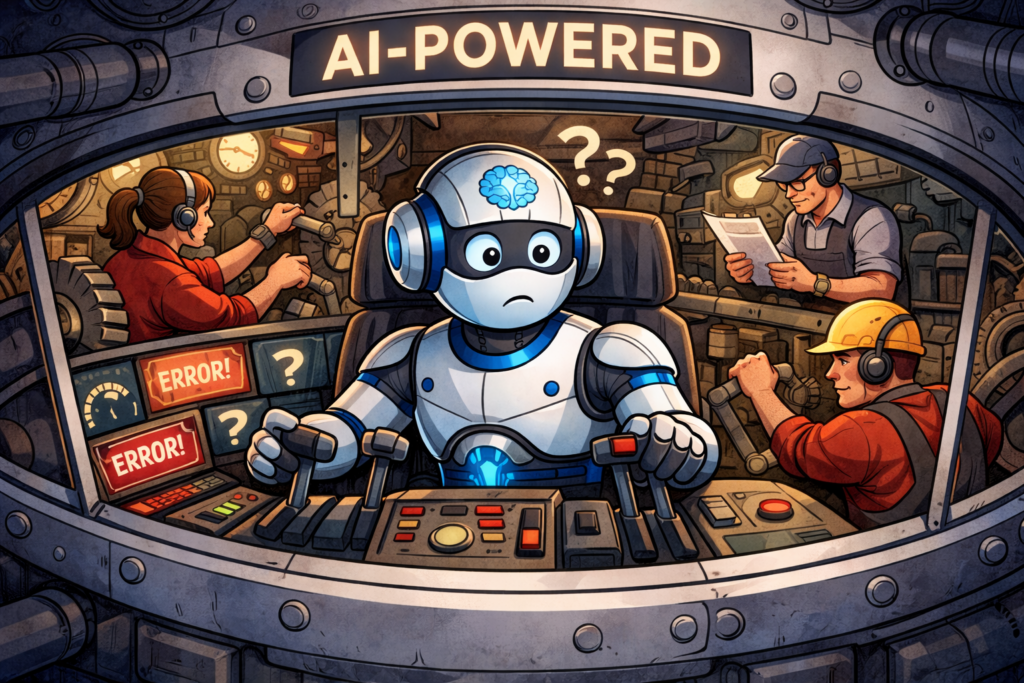
Why “AI-Powered” Is a Misnomer in Home Care Technology
AI is a component — not the engine.
“AI-powered” has quickly become one of the most common phrases in home care technology marketing.
Scheduling is AI-powered.
Documentation is AI-powered.
Engagement is AI-powered.
Forecasting is AI-powered.
The implication is subtle but powerful:
AI is what runs the platform.
That framing is misleading.
AI can absolutely add value in home care software, but it is not the engine that runs daily operations. In practice, AI works best when it is layered on top of something far more important:
Clear workflows, structured data, and human accountability.
Understanding this distinction matters, especially for organizations evaluating home care software and trying to separate real capability from marketing language.
AI in Home Care Software Reflects Data — It Doesn’t Create Intelligence
Most AI used in home care technology today falls into a few practical categories:
- Pattern recognition
- Natural language processing (NLP)
- Recommendation scoring
- Predictive analytics
All of these rely on historical operational data.
AI does not understand your business.
It identifies patterns in the information you already produce.
If intake data is inconsistent…
If schedules are overridden without structure…
If documentation is incomplete or rushed…
Then AI-driven insights will reflect those weaknesses.
AI amplifies data quality — it does not fix broken processes.
This is why two organizations using the same “AI-powered” feature can experience very different outcomes. The difference is rarely the technology itself. It’s the discipline behind how work is executed.
Workflow Design — Not AI — Drives Scheduling and Service Delivery
Scheduling is one of the most commonly marketed AI use cases in home care software.
AI can recommend matches between clients and caregivers.
But it does not define:
- Priority rules
- Compliance constraints
- Pay and margin thresholds
- Geographic tradeoffs
- Continuity versus speed decisions
Those decisions live in workflow design, not artificial intelligence.
A poorly designed workflow with AI layered on top will still produce poor results — just faster and at scale.
Organizations that see strong outcomes tend to start with clear rules, guardrails, and accountability, then use AI to support those workflows.
AI assists execution.
Execution runs the business.
AI Cannot Replace Human Judgment in Regulated Care Environments
Documentation, care plans, and assessments are often described as ideal candidates for AI automation in home care.
AI can help by:
- Reducing repetitive data entry
- Highlighting inconsistencies
- Suggesting summaries
But AI cannot replace:
- Clinical accountability
- Regulatory responsibility
- Contextual judgment
In regulated care environments, human oversight is required by design.
Describing documentation workflows as “AI-driven” can imply a level of autonomy that should never exist in compliance-focused operations. The correct framing is not AI replaces people — it’s:
AI reduces friction so people can focus on higher-value decisions.
Caregiver Engagement and Retention Are Execution Problems, Not AI Problems
AI is increasingly marketed as a solution for caregiver engagement and retention, often through sentiment analysis or predictive risk scoring.
These tools can surface trends.
But engagement challenges usually stem from:
- Inconsistent scheduling practices
- Poor communication
- Unclear expectations
- Reactive support systems
AI can highlight patterns.
It cannot fix leadership, culture, or trust.
Treating retention as a technology problem instead of an execution problem often leads to over-investment in tools and under-investment in fundamentals.
“AI-Powered” Is Not a Home Care Technology Strategy
One of the most common mistakes organizations make is assuming that adopting AI is the strategy.
It isn’t.
A sound technology strategy starts by answering questions like:
- Which workflows have the biggest impact on margin and quality?
- Where do errors originate?
- Which decisions require consistency versus flexibility?
- Where does human judgment add the most value?
Only after those questions are answered does AI become useful — as a targeted capability, not a blanket solution.
When vendors lead with “AI-powered” instead of clearly explaining what operational problem is being solved, they’re selling potential rather than outcomes.
What Actually Runs a Home Care Platform
If AI isn’t the engine, what is?
Strong home care platforms are driven by:
- Clean, structured data models
- Explicit workflow design
- Rule-based decision logic
- Clear handoffs between people and systems
- Accountability across every stage
AI fits inside that foundation — enhancing speed, reducing noise, and surfacing insights — but it does not replace it.
How to Evaluate AI Beyond the Marketing Language
Instead of asking:
“Is this platform AI-powered?”
Ask:
- Where does AI assist — and where does it stop?
- What workflows function without AI?
- How is data governed before AI is applied?
- Which decisions remain human by design?
Platforms that can answer those questions clearly tend to deliver more consistent results than those relying on buzzwords alone.
Final Takeaway
AI absolutely belongs in the future of home care technology.
But the future is not AI-run.
It is AI-assisted, human-led, and execution-driven.
Organizations that understand that distinction make better technology decisions — and avoid costly mistakes.
How SwyftOps Helps Evaluate AI More Clearly
If you’re evaluating AI claims this year, SwyftOps helps teams look beyond marketing language by making execution visible first — so automation supports the work instead of pretending to run it.