
Growth in home care rarely fails because of demand.
More often, it breaks during delivery.
A new client is beginning service. Coverage looks solid. The schedule is filled. But over time, operational friction starts to appear:
- Missed or late visits
- Frequent last-minute schedule changes
- Inconsistent caregiver continuity
- Overtime surprises
- Communication gaps between office and field staff
These issues are rarely caused by effort or intent. They are usually the result of scheduling being treated as a task instead of an operating system.
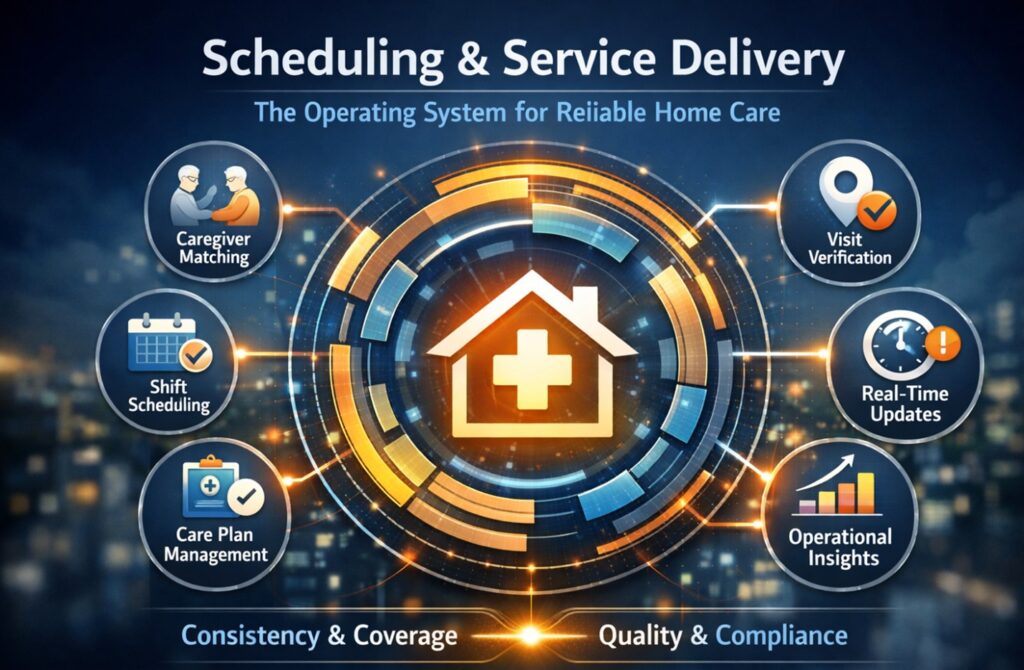
Scheduling and service delivery are not just administrative functions. They are the operational backbone of reliable care.
Scheduling Is More Than Filling Shifts
Many organizations approach scheduling as calendar management:
Match availability → fill shifts → move on.
In reality, service delivery requires balancing multiple constraints simultaneously:
- Client preferences and continuity expectations
- Caregiver availability and skill alignment
- Geography and travel time
- Pay rules and labor considerations
- Compliance requirements
- Real-time changes and unexpected disruptions
When these variables are managed manually or across disconnected systems, scheduling becomes reactive. Teams spend their time solving problems instead of preventing them.
An operating system approach changes the goal.
The objective is no longer simply filling shifts. It is delivering consistent service at scale without increasing operational complexity.
Why Scheduling Breaks as Volume Increases
Scheduling often works early on because relationships and institutional knowledge compensate for missing process. As volume grows, this approach becomes difficult to sustain.
Common breakdown points include:
Knowledge Lives in People Instead of Systems
Schedulers rely on memory and experience rather than structured data. When staffing changes or volume increases, consistency declines.
Continuity Gradually Erodes
Short-term coverage decisions begin to replace long-term alignment between client needs and caregiver relationships, increasing dissatisfaction on both sides.
Exception Management Takes Over
Call-offs, schedule changes, and coverage gaps consume daily operations, leaving little time for proactive planning.
Limited Operational Visibility
Leadership sees filled schedules but lacks insight into overtime risk, service consistency, or operational efficiency.
These challenges are not signs of poor execution. They indicate the absence of a defined scheduling and service delivery operating system.
The Scheduling and Service Delivery Operating System
High-performing home care organizations treat scheduling as a structured workflow made up of interconnected stages:
1. Service Definition
Clearly define required services, cadence, timing expectations, and continuity preferences before scheduling begins.
2. Intelligent Matching
Align caregiver skills, availability, geography, and preferences prior to assigning shifts.
3. Schedule Stabilization
Prioritize consistency to reduce disruption and improve satisfaction for both clients and caregivers.
4. Exception Management
Establish defined processes for call-offs, replacements, and schedule adjustments to prevent cascading disruptions.
5. Communication and Confirmation
Ensure schedule changes are visible and acknowledged by everyone involved in service delivery.
6. Service Verification
Confirm visits occurred as scheduled and capture accurate time and documentation.
7. Continuous Optimization
Use operational data to improve future matching, reduce overtime, and strengthen continuity over time.
When these stages operate together, scheduling becomes predictable rather than reactive.
Technology Should Operationalize the Workflow, Not Replace It
Technology alone does not solve scheduling challenges.
Solutions that promise automation without structured workflows often struggle when real-world constraints collide. Human preferences, geography, compliance, and continuity cannot be fully automated.
Technology works best when it supports an operational framework by:
- Centralizing scheduling and service data
- Making constraints visible before decisions are made
- Enabling smarter matching decisions
- Reducing manual coordination
- Providing real-time operational visibility
When technology aligns with workflow instead of attempting to replace it, teams gain control without adding operational overhead.
Scheduling Is the Beginning of Service Delivery
One of the most important mindset shifts is recognizing that scheduling is not the end of the process.
It is the beginning of service delivery.
Organizations that adopt an operating system approach consistently experience:
- Fewer last-minute disruptions
- Stronger continuity
- Improved caregiver retention
- More predictable operations
- Sustainable growth without operational bloat
How SwyftOps Operationalizes Scheduling and Service Delivery
Defining the workflow is the first step. Executing it consistently requires the right operational foundation.
SwyftOps helps home care operators operationalize scheduling and service delivery by connecting scheduling, communication, service verification, and billing into a single system. This allows teams to move beyond reactive scheduling and operate with greater consistency and visibility as they grow.
If scheduling feels increasingly complex as volume increases, the challenge may not be staffing.
It may be the operating system behind how service is delivered.